


Talk About It Johnsburg – Mental Health Awareness Initiative
Each May, communities across the country recognize Mental Health Awareness Month—a time dedicated to increasing understanding, reducing stigma, and encouraging open conversations about mental health.
The Johnsburg Police Department is proud to support that effort through our “Talk About It Johnsburg” initiative.
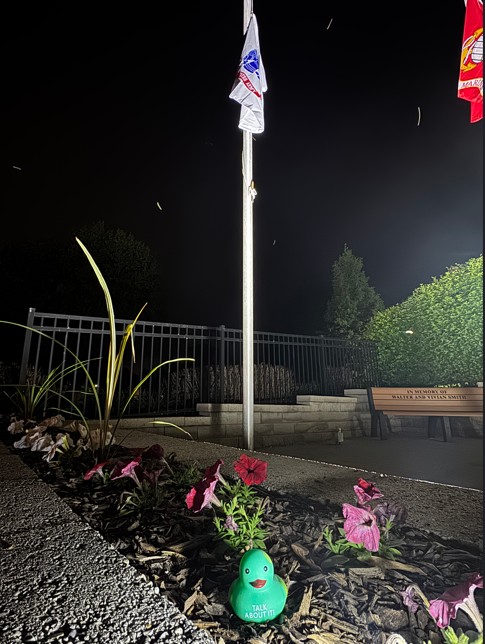
What began in May 2025 as a personal act of remembrance and healing by Sgt. Vollmer has grown into a department-wide community initiative. During the first week of May 2025, Sgt. Vollmer quietly placed green mental health awareness “Talk About It” rubber ducks throughout the Village of Johnsburg. The effort marked the one-year anniversary of the loss of his brother-in-law, Joe, a U.S. Army combat veteran of Operation Enduring Freedom, who died by suicide.
Many of the ducks placed throughout town found new homes within 24 hours. While conducting foot patrols, Sgt. Vollmer would check on the remaining ducks. During the early morning hours the Sunday before Memorial Day, he noticed that one of the ducks had been relocated to a raised flower bed in front of the Veterans Memorial at the Johnsburg Community Club, positioned near the U.S. Army flagpole.
Over the following weeks, that duck stood watch over the memorial, enduring severe weather and numerous Village events. Sgt. Vollmer and other night shift officers continued to check on it and occasionally dust it off before returning it to its place. On the evening of November 12, the night after Veterans Day, it was discovered that the duck was no longer there—it had been relieved of its post.
Each duck represents an opportunity for a conversation about mental health. Each time a duck is found, shared, or passed along, that opportunity grows.
What started as a form of healing for one of our officers has become a department-wide initiative to help reduce the stigma surrounding mental health and to encourage open, honest conversations about not being okay. These small green ducks serve as ambassadors for awareness, reminding us that communication is often the first step toward healing—and that no one has to face challenges alone.
Find a Duck. Start a Conversation.
Throughout the month of May, residents may notice green “Talk About It” ducks placed in parks, public spaces, and around the Village.
Each duck carries a simple but meaningful message: talk about it.
A QR code has been placed on the bottom of each duck, directing individuals to this webpage for quick access to information, mental health resources, and support services.
If you find a duck, you are encouraged to keep it or pass it along to someone else who may benefit from the message.
Mental Health Is More Than One Conversation
Mental health is not limited to one condition, one diagnosis, or one experience. An individual’s understanding of mental health is often shaped by their own personal experiences.
Mental health includes emotional, psychological, social, and biological well-being. It influences how we think, feel, behave, build relationships, and cope with life.
Mental health may include:
Emotional Well-Being
- Self-esteem
- Self-acceptance
Psychological Conditions
- Anxiety Disorders
- Mood Disorders
- Psychotic Disorders
- Personality Disorders
- Eating Disorders
- Addiction and Impulse Control Disorders
- Trauma-Related Disorders
- Neurocognitive Disorders (also commonly referred to as neurodivergent conditions)
Social Well-Being
- The ability to establish and maintain healthy relationships and support systems
Biological Factors
- Genetic influences that may contribute to mental health vulnerabilities
By recognizing the broad nature of mental health, we can better support one another and create a community where asking for help is accepted and encouraged.
Community Outreach & Engagement
As part of this initiative, the Johnsburg Police Department is expanding outreach efforts during the month of May through:
- Increased visibility of mental health resources
- Community-based awareness efforts in parks, neighborhoods, and public spaces
- Direct engagement and support through our Police Social Worker
Residents are encouraged to participate by sharing their experience and helping spread awareness online using:
#TalkAboutItJohnsburg
By posting a photo, sharing a message, or simply using the hashtag, community members can help normalize conversations around mental health and extend the reach of this initiative throughout the community.
Support & Resources
If you or someone you know is struggling, help is available. You are not alone.
Our Police Social Worker, Paul, is available to assist residents with support, guidance, and connections to local services.
Local & National Resources
988 Suicide & Crisis Lifeline
Call or text 988
https://988lifeline.org/
Veterans Crisis Line
Call 988, then press 1
Text 838255
https://www.veteranscrisisline.net/
Crisis Text Line
Text HOME to 741741
https://www.crisistextline.org/
Mental Health America
https://mhanational.org/resources/
McHenry County Mental Health Board
https://www.mc708.org/
NAMI McHenry County
https://namimch.org/
NAMI Homefront (for Veterans & Families)
https://namimch.org/nami-homefront
Pioneer Center for Human Services
https://www.pioneercenter.org/
Thresholds – McHenry Center for Mental Wellbeing
https://www.thresholds.org/programs-services/centers-for-mental-wellbeing/mchenry
Safe2Help Illinois (Student Resource)
Call: 844-4-SAFEIL (844-472-3345)
Text: SAFE2 (72332)
https://www.safe2helpil.com/
Johnsburg Police Department (Non-Emergency)
815-385-6024
Emergency
If you or someone else is in immediate danger, call 911.
How You Can Take Part
- Look for green “Talk About It” ducks throughout Johnsburg
- Scan the QR code on the bottom of the duck
- Keep a duck or pass it along to someone else
- Share your experience using #TalkAboutItJohnsburg
- Take a moment to check in with someone
Closing Message
By starting conversations, increasing awareness, and making resources more accessible, we can help reduce stigma and build a stronger, more supportive community.
Together, we can make a difference—one conversation at a time.